
18 Nov tttt
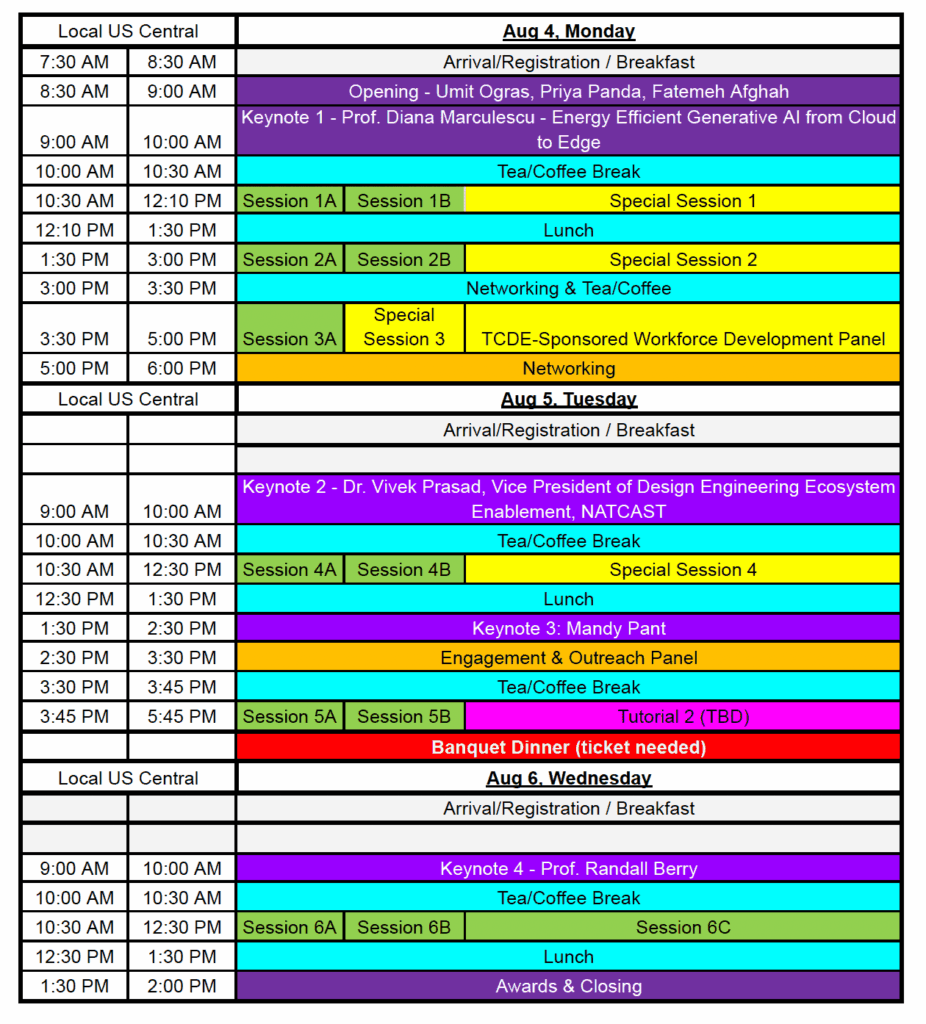

Keynote Speaker: Diana Marculescu
Title: Energy Efficient Generative AI from Cloud to Edge
Abstract: Machine learning (ML) applications have entered and impacted our lives unlike any other technology advance from the recent past. While the holy grail for judging the quality of a ML model has largely been serving accuracy, and only recently its resource usage, neither of these metrics translate directly to energy efficiency, latency, or mobile device battery lifetime. More recently, generative AI relying on transformer, diffusion, or state-space models have revolutionized the way we approach reasoning and learning tasks across all types of modalities, from image to video and language, bringing increased performance at the expense of significant hardware costs. This talk uncovers the need for building accurate, platform‐specific power and latency models and efficient hardware-aware design methodologies for ML systems, thus allowing machine learners and hardware designers to identify not just the best accuracy ML configuration, but also those that satisfy given hardware constraints. Furthermore, together with model compression techniques, such as quantization and sparsity-aware co-design, these approaches demonstrate the feasibility of achieving cloud to edge real-time, efficient generative AI for multi-modal tasks.
Bio: Diana Marculescu is Department Chair, Cockrell Family Chair for Engineering Leadership #5, and Professor, Motorola Regents Chair in Electrical and Computer Engineering #2, at the University of Texas at Austin. She serves as the Founding Director of the iMAGiNE (Intelligent Machine Engineering) Consortium, a joint industry-university partnership for engineering the machines that support intelligent applications from cloud to edge. Prior to joining UT Austin in December 2019, Diana was the David Edward Schramm Professor of Electrical and Computer Engineering, the Founding Director of the College of Engineering Center for Faculty Success (2015-2019) and has served as Associate Department Head for Academic Affairs in Electrical and Computer Engineering (2014-2018), all at Carnegie Mellon University. She received a Dipl. Ing. degree in computer science from the University “Politehnica” of Bucharest, Romania (1991), and a Ph.D. degree in computer engineering from the University of Southern California, Los Angeles, CA (1998). Her research interests include energy- and reliability-aware computing, hardware aware machine learning, and computing for sustainability and natural science applications. Diana is a recipient of multiple awards, including the National Science Foundation Faculty Career Award (2000-2004), the ACM SIGDA Technical Leadership Award (2003), the Carnegie Institute of Technology George Tallman Ladd Research Award (2004), and several best paper awards. She was an IEEE Circuits and Systems Society Distinguished Lecturer (2004-2005) and the Chair of the Association for Computing Machinery (ACM) Special Interest Group on Design Automation (2005-2009). Diana chaired several conferences and symposia in her area and served as Associate Editor for several ACM and IEEE journals. She was selected as an ELATE Fellow (2013-2014), and was the recipient of an Australian Research Council Future Fellowship (2013-2017), the Marie R. Pistilli Women in EDA Achievement Award (2014), and the Barbara Lazarus Award from Carnegie Mellon University (2018). Diana is a Lifetime Fellow of ACM, and a Fellow of IEEE and AAAS.

Keynote Speaker: Mandy Pant
Title: Moore’s Law in the AI era
Abstract: This talk explores the profound impact of Moore’s Law on technological breakthroughs and its continuing influence in today’s evolving AI landscape. We’ll discuss how Moore’s Law remains a key driver of innovation while highlighting other emerging factors—such as the need for workforce development and overcoming environmental impacts—that must be addressed as we push forward in advancing artificial intelligence. Attendees will gain insights into current challenges, including shifting economic trends and talent gaps, which could affect future progress. By linking past achievements with upcoming opportunities, the speaker will address why understanding Moore’s Law and these additional factors is essential for forecasting the future of AI—and adapting as the pace of change shifts.
Bio: Dr. Mondira (Mandy) Deb Pant has recently taken up a role as TA-Chief of Staff, Lead Technologist for Intel’s Design Engineering Group as of April 2021. In her previous role, she served as Academic Research Director and Principal Engineer, working with leading academic researchers worldwide and senior technical leaders at Intel to seed and drive research efforts in areas of strategic importance to Intel in particular and the computing industry in general. She has served as Intel’s lead technologist in the area of power delivery and power management on Intel server microprocessors. She has published 20+ technical papers in prestigious VLSI conferences and journals, has 3 issued patents and 5 pending patents. She has been given the distinguished SRC (Semiconductor Research Corporation) Champion award for 2021. Mandy received her Bachelors in Computer Science and Engineering from I.I.T. Kharagpur, India, and a Masters and Doctorate in Electrical Engineering from Georgia Tech, Atlanta. She joined Intel in 2001 as part of the Alpha team acquisition from Compaq Computer Corporation where she worked since graduating in 2000. In 2019, she served as the Technical Chair for DTTC, Intel’s biggest internal technical conference. She currently serves as the IEEE-Computer Society TCVLSI Chair and Editor-in-Chief for the TCVLSI newsletter.

Keynote Speaker: Vivek Prasad
Title: Chips Act & Systems of Support for US Semiconductor Ecosystem
Abstract: After facing stark supply-chain and manufacturing challenges since 2020, the US semiconductor industry started to reinvent itself on multiple fronts. US lawmakers rose up to the occasion and passed the US Chips and Science Act of 2022 with very broad bipartisan support. The National Semiconductor Technology Center (NSTC) created Natcast, a non-profit start-up to execute on the vision and goals defined by the chips act. Natcast’s members benefit from wrap-around support that will enable them to leverage the existing success and momentum of the entire membership instead of starting from scratch in isolation. In this presentation you will hear how Natcast is planning to implement NSTC’s vision on all fronts: prioritizing and funding research, design enablement, silicon aggregation, labs and facilities, venture funding, data aggregation, and more. In particular, the presentation will focus on design enablement and silicon aggregation support aimed at accelerating concept to silicon including co-development in system and software contexts.
Bio: Vivek Prasad has 30+ years of experience in the EDA industry with various roles in R&D, product strategy, business development, as well as his favorite role: customer success. He is one of the earliest and steadfast pioneer and advocate of pre-silicon hardware/software co-design and co-verification. For almost 2 decades, he worked closely with his customers to expand use-cases running on FPGA-based ZeBu emulators and later expanding to HAPS prototyping platforms. Under his leadership, he and his team practiced a one-team approach with their customers to accelerate HW/SW readiness and post-silicon bring-up. He was then invited to Intel to spearhead their initiative to reduce post-silicon issues by enhancing pre-silicon system level validation, augmented with a robust test-chip and external customer engagement strategy in pre-silicon. Vivek is now leading the Design Ecosystem Enablement function at Natcast – the operator of National Semiconductor Technology Center (NSTC) created as part of the CHIPS for America Vision. In this mission-driven role, he is committed to create a wraparound support system for the semiconductor research and start-up ecosystem of our country!
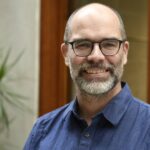
Keynote Speaker: Randall Berry
Title: Meeting the Spectrum Needs of Next Generation Wireless Systems
Abstract: Wireless networks such as cellular and WiFi have experienced significant growth over the last two decades to become a ubiquitous part of our daily lives. A key ingredient to support the continued growth of these systems is access to wireless spectrum,. Several bands are currently being considered to meet these demands including the lower 3 GHz band and the 7-8 GHz band, both of which are currently used by various federal incumbents. There are two main approaches to enable commercial use of such bands, either clearing spectrum by moving the incumbents out of a band or sharing spectrum with incumbent users. We will discuss the trade-offs between these two approaches and the challenges in determining the path forward. These trade-offs in turn depend on the economic impact of different approaches on the market for wireless services. We will discuss a framework for gaining insight into this based on game theoretic models for competition with congestible resources. We will utilize this framework to illustrate potential impacts of different approaches for providing spectrum to next generation wireless services.
Bio: Randall Berry joined Northwestern University in 2000, where he is currently the Chair and John A. Dever Professor in the Department of Electrical and Computer Engineering. His research interests span topics in wireless communications, computer networking, network economics, and information theory. Dr. Berry received the M.S. and PhD degrees in Electrical Engineering and Computer Science from the Massachusetts Institute of Technology in 1996 and 2000, respectively, where he was part of the Laboratory for Information and Decision Systems. Dr. Berry is the recipient of a 2003 NSF CAREER award and an IEEE Fellow. His research has been recognized with best paper awards at WiOpt, IEEE DySPAN and the IEEE Workshop on Smart Data Pricing. He is currently the Steering committee chair for IEEE DySPAN and has served as a TPC chair for the IEEE ICC Wireless Networking Symposium and ACM MobiHoc. He has also served as an Editor for the IEEE Transactions on Wireless Communications and the IEEE Transactions on Information Theory and has a founding Area editor for the IEEE Open Journal of the Communications Society.
Sorry, the comment form is closed at this time.